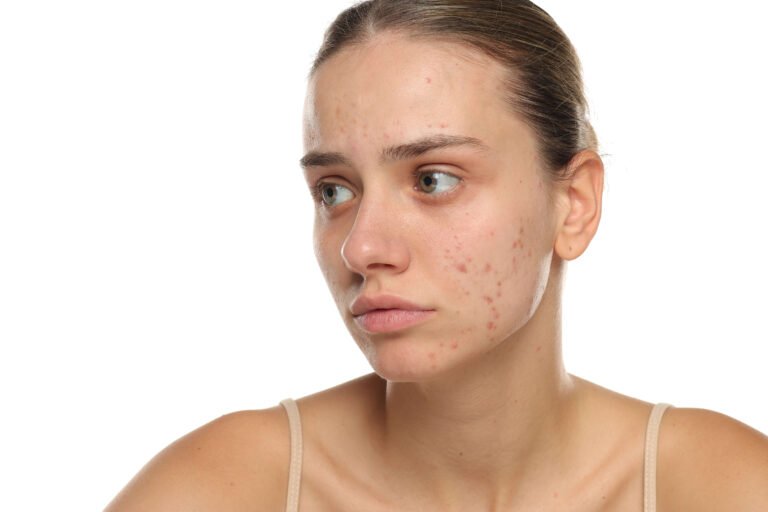
A rash appears around the mouth. It looks like acne, so it gets treated like acne — and it does not improve. Then a cortisone cream helps for a week, and everything gets worse when it stops.
Perioral dermatitis is an inflammatory rash of the facial skin that most often affects women between the ages of 20 and 45, although men and children develop it as well. It is common, it is harmless in itself, and it is among the most frequently mistreated conditions in dermatology. Is it acne? Is it an allergy? Is it dryness? Did the toothpaste cause it? Does the cortisone cream help or harm? And why does it return every time the cream is stopped? These are the questions people arrive with, and the answers are usually not the expected ones.
What Is Perioral Dermatitis?
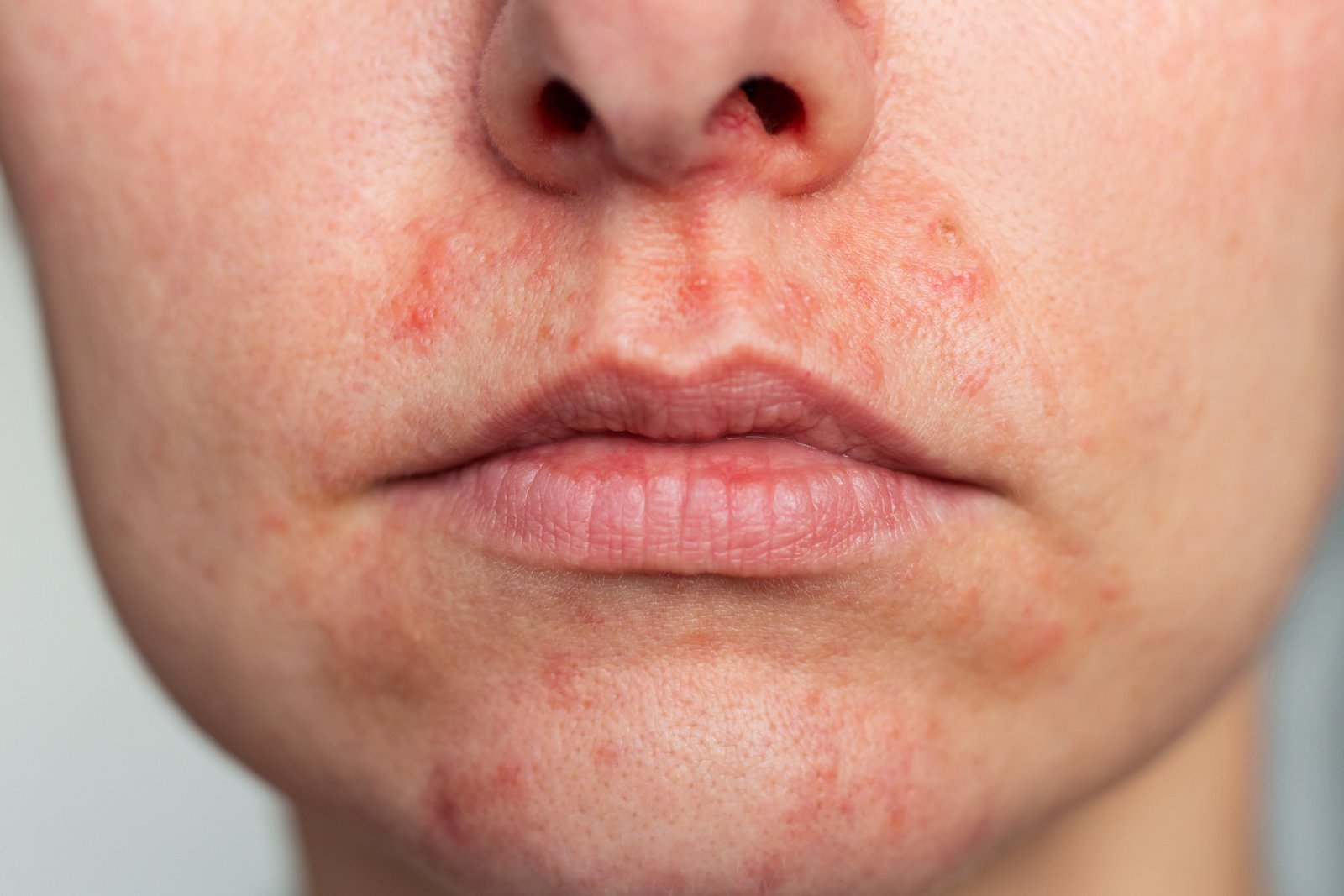
Perioral dermatitis appears as crops of small bumps around the mouth, sometimes with fine scaling. Some of the bumps may contain a little clear fluid.
Despite the name, it is not limited to the mouth. The same rash can appear around the nostrils and, in some people, around the eyes. Periorificial dermatitis is the more accurate term.
Burning and tightness are the usual complaints. Itching happens, but it is less typical — a useful difference from eczema, where itching dominates.
Two things are worth saying at the start, because they are the first worries for most people. This rash is not contagious. And it has nothing to do with poor hygiene. If anything, it is more common in people who take a lot of care with their skin.
One more point that medical descriptions usually leave out: a visible rash in the middle of the face, lasting months, is not easy to live with. Its effect on mood and confidence is documented, not assumed. That alone is a reason to seek help.
How Is It Different From Acne?
The most useful sign is one that most people never notice on their own face.
The clearest clue is not where the rash appears. It is the narrow band of skin left untouched at the very edge of the lips.
The skin right at the lip edge — the vermilion border — is usually spared, leaving a thin band of normal skin between the lips and the rash. Acne does not respect that border. Eczema does not either. When this clear rim is there, it changes the picture considerably.
Two other differences matter. Blackheads and whiteheads are absent in perioral dermatitis, while they define true acne. And the bumps are unusually uniform: dozens of similar small bumps at the same stage, rather than the mixed picture of acne.
The third clue is not visual. Acne slowly improves under acne treatment. Perioral dermatitis often gets worse. Benzoyl peroxide and strong acids inflame skin whose barrier is already disturbed. When “acne” around the mouth deteriorates under acne care, that reaction is itself an answer. If your breakouts do behave like acne, our guide to adult acne covers what drives it and why it persists.
Does Perioral Dermatitis Look Different on Darker Skin?
Yes, and this is one of the main reasons the condition goes unrecognised.
Almost every description of perioral dermatitis, including the one above, starts with the word red. On lighter skin that is accurate. On brown and black skin it often is not. Pigment masks the underlying redness, and the rash appears skin-coloured, reddish-brown, or darker instead. Someone looking in the mirror for a red rash finds nothing that matches, and rules themselves out.
On lighter skin
- Red, acne-like bumps
- Redness is obvious
- Leaves a pink mark as it settles
On brown and black skin
- Skin-coloured, reddish-brown or darker
- Redness is masked by pigment
- Leaves a brown mark, slower to fade
This is not theoretical. Perioral dermatitis is underdiagnosed and misdiagnosed in skin of colour, and treatment is delayed as a result.
A second problem makes the first one worse. On deeper skin tones, steroid creams used around the mouth and eyes can lighten the skin. Since a steroid cream is usually what was applied to the rash first, the treatment can erase the very signs a doctor would look for.
There is also an after-effect worth knowing. Once the rash settles, longer or more severe inflammation can leave flat brown marks where the bumps were. These are not scars and they are not permanent, but they can take weeks to months to fade. That is a good reason not to pick at the rash, and not to treat it aggressively.
What Else Looks Like This?
| Condition | What it looks like | The separating detail |
|---|---|---|
| Perioral dermatitis | Looks likeUniform small bumps around the mouth, fine scale, burning | Separating detailVermilion border spared; worsens off-steroid |
| Acne | Looks likeMixed lesions of different types and stages | Separating detailBlackheads and whiteheads present; no lip-border sparing |
| Seborrheic dermatitis | Looks likeGreasy yellowish scaling in the nose folds and brows | Separating detailScaling dominates over bumps; scalp usually involved |
| Irritant or allergic eczema | Looks likeItchy, more diffuse redness, may reach the lip border | Separating detailItch dominates; tracks contact with a specific product |
Overlap is common — perioral dermatitis and seborrheic dermatitis in particular can occur together on the same face. A table narrows the possibilities; it does not close them.
Around the mouth, at least four conditions look nearly identical — and two of them get worse under acne treatment.
Join the WaitlistThe personalised report is being prepared — early access, no payment now.
What Causes Perioral Dermatitis?
The cause is only partly understood, and it is most honestly presented in order of how strong the evidence actually is.
The strongest and most consistent association is with topical corticosteroids applied to the face. This link is reported so consistently that a history of steroid cream use is among the first questions asked in clinic, and it is reflected in the American Academy of Dermatology’s guidance on the condition. It applies to prescription steroid creams, to creams borrowed from a family member for another purpose, and — less obviously — to inhaled and nasal steroid sprays, where the medication reaches the skin around the mouth and nose.
Layered cosmetic products come next, and here there is a figure worth knowing. In an Australia-wide study of 133 people with perioral dermatitis and 99 matched controls, using foundation on top of a moisturiser and a night cream was linked to roughly thirteen times the odds of having the condition. Moisturiser plus foundation carried a smaller but still clear increase. Moisturiser alone showed no increased risk at all.
That last detail is the important one. The problem does not appear to be moisturiser. It is the stacking — layer on layer, with foundation sealing it — which is thought to work by occluding the skin. The study is old, and it compares groups by questionnaire rather than testing anything, so it shows an association rather than proving cause. But it matches what is seen in practice, and it explains why this condition tends to appear in people with long routines rather than neglected skin.
Individual ingredients have also been proposed, with weaker support: ointments and creams with a petrolatum or paraffin base, isopropyl myristate, sodium lauryl sulfate, fragrances, and overuse of actives such as retinoids.
Occlusion from something other than skincare belongs in the same group. Cases have been reported following prolonged face mask use, and the mechanism is the same one that makes layered cosmetics a problem: warmth, moisture and friction held against the skin for hours. This is worth knowing for anyone who wears a mask regularly at work.
Hormonal factors are suspected but not established. The strong female predominance between 20 and 45, and reports of flares around hormonal changes, point in that direction without proving it.
And in a meaningful proportion of cases no trigger is ever identified. This should be said clearly: many people develop this rash without having done anything wrong.
Does Toothpaste or Diet Cause Perioral Dermatitis?
Neither is well supported.
Fluoride and tartar-control toothpastes are often named, but the research behind this is thin — nothing close to the steroid or cosmetic associations. Changing toothpaste is harmless and cheap, so there is no reason to argue with anyone who wants to try. It is just unlikely to be the answer on its own.
Diet is a newer addition, and the evidence is weaker still. Gluten is sometimes blamed, but this rests on individual impressions rather than proper study. There is no good evidence that cutting out gluten, salt, or spice treats perioral dermatitis.
This matters more than it sounds. A lot of time is lost changing toothpastes, cutting out foods, and washing pillowcases while a steroid cream — the best-supported cause of all — stays in the routine.
Can You Wear Makeup With Perioral Dermatitis?
This is the question people are most reluctant to ask, and it deserves a straight answer.
During a flare, the honest advice is to wear as little as possible — and the reason is the study above, not discipline. Foundation layered over moisturiser and night cream was the combination most strongly linked to the condition. Adding coverage to a flare adds exactly the variable the evidence points to.
Even so, telling someone to go without makeup for two months ignores what a visible facial rash costs them at work or in front of other people, and advice like that tends to be dropped rather than followed. The workable compromise is fewer layers, not a “gentle” product added on top: fewer products overall, lighter textures, nothing heavy underneath, and gentle removal rather than scrubbing. What sits under the makeup matters more than which makeup it is.
Why Does the Rash Return When You Stop the Cream?
Because suppression is not resolution. The sequence is worth following step by step, since understanding it is what allows people to break out of it.
A topical steroid is applied → the inflammation is suppressed and the rash visibly improves within days → the skin adapts to the steroid’s continued presence → the steroid is stopped → the suppressed inflammation returns, often over a wider area than before → the rash now looks worse than at the start → the cream is restarted, because it is the only thing that ever appeared to work → and the cycle begins again, usually from a slightly worse baseline each time.
Every turn of this cycle makes the condition harder to settle. This should be said plainly: the cream is not the ladder out of the hole. It is the shovel.
What Actually Helps?
Three things, in this order.
Stopping the topical steroid — if one is being used. Where a steroid cream is in the picture, and particularly where it has been used on the face for weeks or months, stopping it comes first: nothing else works reliably while it continues, and the flare that follows is temporary and expected. If no steroid has ever been applied, this step simply does not apply, and the sequence begins at the next one.
Simplifying the routine substantially. In this condition, subtraction outperforms addition. A gentle cleanser and, for a period, little or nothing left on the skin is a recognised approach, and mild cases often settle on this alone. Layering barrier creams and spot treatments over the rash tends to feed the occlusion the condition thrives on.
Prescription treatment where a clinician judges it appropriate. Established options exist and have been reviewed systematically; topical anti-inflammatory preparations and oral antibiotics from the tetracycline family are the usual directions. Which one, at what strength, and for how long depends on severity, age, whether the eyes are involved, and what the skin has already been through. That is where a general article should stop and a consultation should begin.
What does not help, despite being tried constantly: stronger acne actives, richer moisturisers, and one more course of the cortisone cream.
One more thing should be said, because most articles leave it out. A proportion of cases do not settle on the standard approach. Published reports describe perioral dermatitis persisting through repeated courses of the usual treatments, and there are no firmly established guidelines for what to do next.
Where the usual options fail, dermatologists have others — among them oral ivermectin, topical calcineurin inhibitors, and low-dose oral isotretinoin, which has controlled cases that resisted everything else. The evidence for these rests on case reports and small series rather than large trials, and isotretinoin in particular requires close monitoring and cannot be used in pregnancy. One detail is worth knowing in advance: lesions sometimes flare in the first days of isotretinoin before they improve, which has led people to stop it too early.
None of this is something to arrange alone. If your case fits this description, it is not a personal failure and it does not mean nothing will work — it means the case has moved past what a general article can usefully cover, and it belongs back in front of a dermatologist rather than in another cycle of the same products.
How Long Does It Take to Clear?
After a topical steroid is stopped, the rash commonly worsens before it improves. This is the stage at which most people restart the cream and reset the cycle. Knowing that it is coming is, in practice, half the treatment.
Treatment generally needs at least this long to show meaningful improvement, and complete clearing often takes a few months. Judging success at week two is the most common way people conclude, wrongly, that a correct approach has failed.
Two more points are worth setting out, because they cause a lot of unnecessary worry.
Improvement is not linear. The bumps usually settle before the colour does, and some discoloration often remains after the active rash has gone — pink on lighter skin, brown on deeper skin tones. That colour is a mark left by inflammation, not continuing disease, and it fades on its own over weeks to months.
One correction, since it circulates widely: the ups and downs during recovery are not the skin “releasing toxins” from deeper layers. Skin does not clear toxins this way, and no such mechanism is described in the dermatological literature. What happens is simpler — inflammation settles unevenly, and ordinary triggers like stress and weather keep influencing it while it does.
What About Children?
Children get this rash too, and their version can look different enough to be missed. A granulomatous form is described more often in childhood: the bumps are yellow-brown rather than red, and can spread beyond the face to the ears and neck. It is reported particularly in children with deeper skin tones.
Because the appearance is unusual, and because steroid creams are so often applied to a child’s face before anyone considers this diagnosis, a persistent rash around a child’s mouth, nose, or eyes is worth having examined rather than treated by trial and error.
Can Perioral Dermatitis Turn Into Rosacea?
The relationship between the two is genuinely debated. Some authors classify perioral dermatitis within the rosacea family rather than as a separate condition, and recurrent cases are sometimes described as evolving toward a rosacea pattern. Others treat them as distinct entities that share features and triggers.
What can be said with reasonable confidence is that the two overlap, that both are provoked by topical steroids on the face, and that persistent facial redness continuing after the bumps have resolved deserves to be assessed on its own terms rather than assumed to be leftover perioral dermatitis.
The hardest stage of this condition is neither the diagnosis nor the prescription. It is the two to four weeks after the steroid cream is stopped, when the rash briefly looks worse than before. Almost everyone who goes back to the cream does so in this window, and the cycle starts again.
This rebound is expected, it is temporary, and it is the price of leaving the cycle rather than a sign of failure. Knowing that in advance is what separates the people whose skin clears in two months from those who spend a year going back and forth with the same tube.
It is also worth remembering that a product which suited someone you know may not suit your skin, that the same rash can have different causes in different people, and that on deeper skin tones the visual clues described here are less reliable. Working out which applies to you is what the personalised report is being built to do.
Frequently Asked Questions
To summarise: small uniform bumps around the mouth, a clear band at the lip border, no blackheads or whiteheads, worse under acne treatment, and returning each time a cortisone cream stops — that pattern fits perioral dermatitis. On deeper skin tones the same rash may look brown or skin-coloured rather than red, which is a common reason it is missed. The strongest known cause is steroid cream on the face; layered cosmetics come next; the toothpaste and diet theories are weak. Treatment means taking things away rather than adding them, and improvement is measured in weeks to months.
What is written here covers only part of the subject, and it does not replace treatment. Facial rashes overlap a great deal, and telling perioral dermatitis from seborrheic dermatitis or an irritant reaction is not always obvious even in person. If the rash has lasted, is spreading, involves the eyes, or has already been through several failed treatments, seeing a dermatologist is recommended before another product is added.
You now know why this rash resists acne treatment, and why the cortisone shortcut backfires.
What remains is whether this is the pattern your own skin is showing.
Join the WaitlistMedical Disclaimer: This article is for informational purposes only and does not constitute medical advice, diagnosis, or treatment. Perioral dermatitis and the conditions that resemble it require professional evaluation for accurate diagnosis. Always consult a qualified healthcare provider regarding your individual condition.