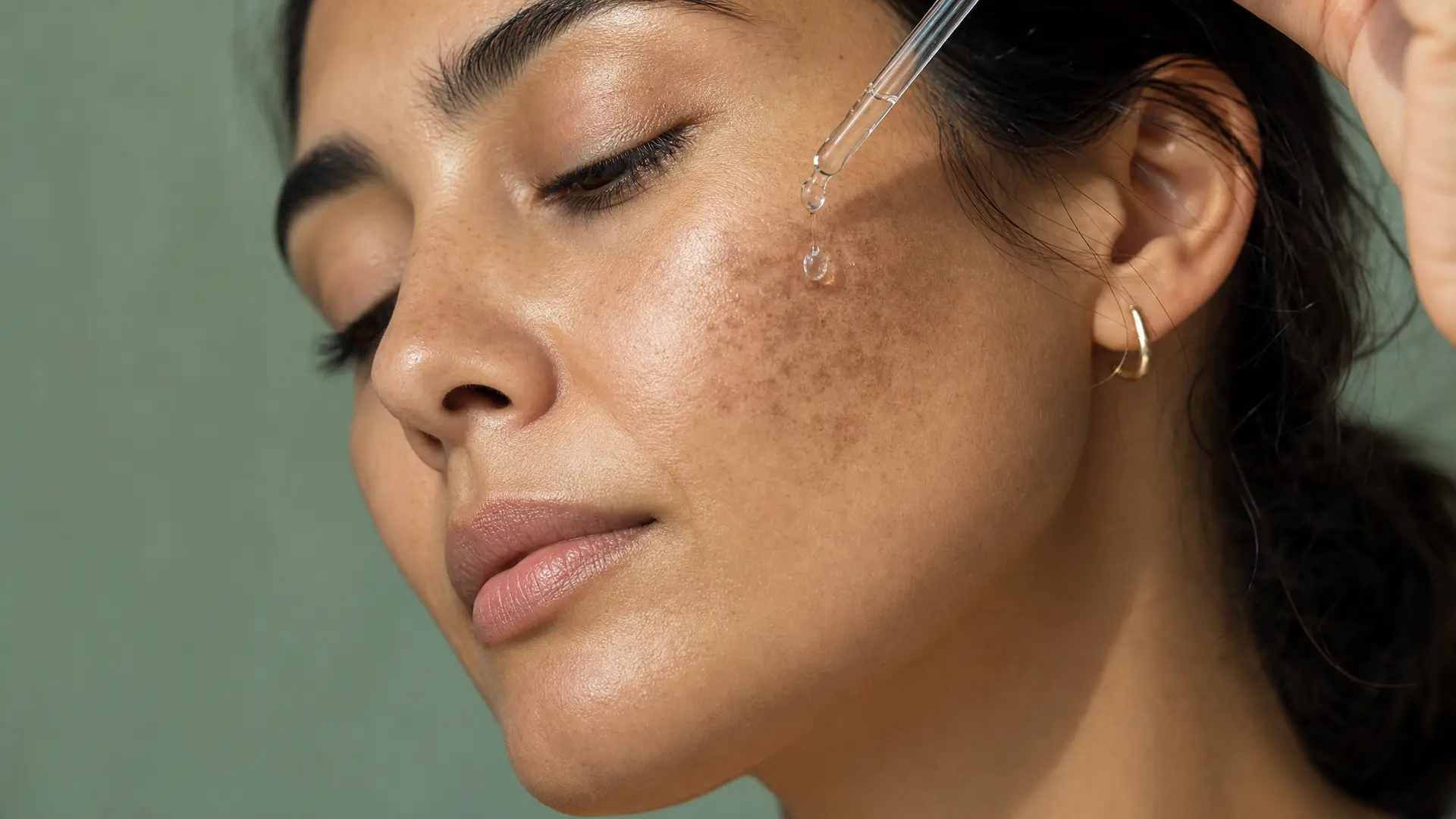
The serums all promise to “brighten” — but the labels read like a chemistry exam. Here’s what each of these skin brightening ingredients really does, and how solid the science behind it is.
Thiamidol. Cysteamine. Kojic acid. Niacinamide. Malassezin. The labels promise the same thing — fewer dark spots, more even tone — but these ingredients are nowhere near equal. Some have decades of trials behind them. Some are mostly marketing. This guide sorts the whole shelf by how each one works, and how strong the evidence really is.
If you’ve tried a brightening product, waited two months, and seen nothing — the problem usually isn’t your skin. It’s that most people pick ingredients blind. But before any single ingredient, one fact reframes the whole thing:
Nearly half the sunlight reaching your skin is visible light, not UV — and most sunscreens barely touch it. No brightening ingredient works without sun protection over it. It’s the step most routines get wrong first.
That’s why sun protection comes first — ideally a tinted sunscreen with iron oxides, which (unlike most) also screens visible light. Now to the ingredients. They all work by stepping into one short process.
How Pigment Forms — and Where to Interrupt It
Your skin makes a pigment called melanin. Think of it as a short factory line with four steps: something switches it on, an enzyme does the work, the pigment gets made, then it’s passed up to the surface — where you finally see it as a spot. Every brightening ingredient works by stepping in at one of those points. Below, the four families are mapped to exactly where each one acts.
Four ways to interrupt pigment — where each one acts.
Each family in the decoder below belongs to one of these four. Some ingredients are topical, some oral — but they all act through one of these four routes.
Keep that in mind. The decoder below sorts every skin brightening ingredient into these steps, one by one.
Brightening Myths, Busted
“Natural ingredients are gentler and safer than ‘chemical’ ones.”
Plant-derived brighteners can work — but “natural” tells you nothing about safety or strength.
Some of the best-studied botanicals sit right next to actives with thin evidence and real irritation potential. The useful question is never natural vs. chemical — it’s how strong the evidence is, and how well it’s formulated.
“A higher percentage works faster.”
Past a point, more active means more irritation — not more brightening.
An inflamed, barrier-damaged complexion actually produces more pigment, not less. With acids and strong actives especially, pushing the concentration often sets results back.
Knowing what an ingredient does is step one. Knowing which belongs in your routine is the harder part.
Join the WaitlistSkin Brightening Ingredients, Grouped by How They Work
Tyrosinase Inhibitors
The pigment “off switch.” Tyrosinase is the rate-limiting enzyme of melanin — slow it down, and the pigment factory eases off. This is the most crowded, best-studied family.
The long-standing reference standard. Blocks tyrosinase directly and remains the agent most others are measured against.
Singled out as the most potent inhibitor of human tyrosinase in a screen of 50,000 compounds, with a notably fast onset — visible work within a couple of weeks. It’s the active behind several mass-market “anti-pigment” lines, so you’ll see it everywhere. Effective in studies, though direct head-to-head proof against hydroquinone is still limited.
An antioxidant aminothiol that hits two targets at once — tyrosinase and peroxidase. Multiple reviews now place it on par with hydroquinone, which is why it’s become a popular hydroquinone-free option, sold as leave-on or short-contact creams. Older versions had a sulfur smell; newer formulas have largely solved it.
A quiet multitasker: it eases down the pigment enzyme while calming inflammation, which is why it’s reached for in melasma and the brown marks acne leaves behind — and doubles as an acne and rosacea ingredient. Unlike most brighteners, it’s generally considered compatible with pregnancy. The trade-off is patience — it works over months, and stronger strengths are prescription-only.
A fungal-derived option that ties up the copper at tyrosinase’s core. Reasonable evidence, though it can be sensitising for some skin.
Hydroquinone’s gentler relative — a naturally derived molecule that eases down the same enzyme, more slowly and with less irritation. Look for the alpha-arbutin form, the more stable and potent one. Milder than prescription options, which is exactly its appeal for sensitive skin or anyone easing in.
Antioxidants
Pigment often begins with oxidative stress and light. These agents work upstream — calming the trigger before melanin ramps up. Some are applied to the skin; others are taken by mouth to buffer it from the inside.
A dual-action staple: an antioxidant that also nudges down the pigment enzyme, so it both buffers against daily light and slowly evens tone. The catch is chemistry — pure forms oxidise in light and air, so packaging and freshness matter more than the percentage on the label. Best worn in the morning alongside sunscreen, not as a stand-alone spot eraser.
The internet’s favourite — and, for once, mostly deserved. It’s among the best-evidenced over-the-counter options, though not for the reason people assume: it doesn’t stop pigment being made, it blocks pigment being passed to surface skin cells, and it supports the barrier. Gentle and compatible with almost everything — a dependable supporting act rather than a headline cure.
A plant antioxidant with a small but real trial record — effective with fewer side effects than its prescription comparators in one study.
Popular antioxidants with thin topical evidence — reasonable supporting players, not headline acts. Injectable (IV) glutathione is a separate, riskier matter — and not a DIY route.
A fern extract taken by mouth — a systemic antioxidant that buffers the skin against UV damage and inflammation from the inside. Most useful layered on top of topical treatment and daily sunscreen.
Oral antioxidant supplements (from tomato and pine bark) studied as adjuncts that support a topical plan — supportive, not central.
The New Science
The frontier — agents that act through entirely different cellular switches. Genuinely interesting, mostly early-stage, and where the field is moving fastest.
The standout: a molecule made by a yeast that lives on everyone’s skin. It flips a receptor called the aryl-hydrocarbon receptor and nudges pigment cells to step back — notably, not by blocking tyrosinase. Early head-to-head data looks promising.
The diabetes tablet, repurposed for the skin — it turns down pigment through a different internal signal (cAMP). Early trials are encouraging.
A mixed bag of newer ideas. Methimazole blocks a different pigment enzyme; exosome and “stem-cell” products are heavily marketed but, sold over the counter, are not equivalent to clinical procedures.
A different route entirely — it works on the blood-vessel side of pigment, not just the melanin, which is why it helps the redness-tinged type of melasma. It comes both as a topical (in serums) and, under medical supervision, as a low-dose oral tablet. The oral form carries real contraindications, so it’s firmly a dermatologist’s call — not a DIY ingredient.
Surface Renewal
A different lever entirely: speed up how fast skin cells turn over, and pigmented cells are carried to the surface and shed sooner.
Exfoliants that lift surface pigment and help other actives absorb. Easy to overdo — more is not faster, and an irritated barrier can make pigment worse.
Turn over cells faster and make pigment-fighting partners work harder. Powerful, but they reward patience — rushing them backfires.
This decoder explains what these ingredients are and how strong the evidence is — it is not a usage guide. Prescription, off-label, and in-clinic agents in particular should only ever be used under the guidance of a dermatologist, who can weigh them against your skin type, history, and other treatments.
When a Dark Spot Needs a Doctor — Not a Serum
The Dermatologist’s Take
After years in clinic, it comes down to one thing: protect the skin barrier. Most brightening doesn’t fail because the ingredient is wrong — it fails because the skin gets irritated, and irritated skin makes pigment worse.
So go slow. Use less, not more. Calm the skin first, add one active at a time, and give it months, not weeks.
You now understand what every ingredient does. You still don’t know which ones belong on your face.
That’s the exact gap we’re built to close.
Reserve My SpotA $9 report · Morning & evening routine · Product matches · When to see a doctor
Frequently Asked Questions
Reviewed by a practicing dermatologist with 15+ years of clinical experience. All content checked against current AAD and EADV guidelines before publication. About our editorial standards →
Medical Disclaimer: This content is for informational and educational purposes only and does not constitute medical advice, diagnosis, treatment, or a substitute for professional dermatological care. If you have a persistent, changing, or concerning skin condition, please consult a dermatologist.